Pages

Monday, December 26, 2011

Persimmons on fire

I read an interesting article on how to write a blog post. The advice was to delete the first and last paragraphs, so this is a very short first paragraph. No deletion required.

Christmas dinner came together without a hitch, and in a rather effortless fashion. Brother Joe and his wife Nancy sent us a "honey baked ham". We tried champagne and sherry with the ham, but with the leftovers on Boxing Day tried this Simply Recipes Honey Mulled Wine which is also recommended.

After our late afternoon Christmas Day dinner, we had John's famous flaming persimmon pudding. His mother used to serve flaming puddings, with decorations of holly and berries. Here is a video of the pudding:


Courtesy of John, here is the persimmon pudding recipe - his adaptation from the "California Heritage Cookbook" by the Pasadena Junior League.

Persimmon Pudding
1 cup granulated sugar
1 tablespoon salad oil
1 egg, well beaten
1 cup flour
1/2 tsp. kosher salt
1 tsp. ground cinnamon
1/4 tsp. ground cloves
1/4 tsp. ground ginger
1/4 tsp. allspice
1/4 tsp. nutmeg
1 tsp. baking soda
1 tsp. baking powder
1/4 cup milk
1 cup Hachiya persimmons, sieved
1/2 tsp. vanilla extract
1/2 cup chopped toasted pecans
1/2 cup chopped dates
1/4 cup chopped candied ginger, no smaller than 1/8" chunks

In a mixing bowl, beat one cup sugar and the oil into the well-beaten egg. In a separate bowl sift together the flour, spices, salt, baking powder and soda. Add this alternately with the milk to the creamed mixture. Mix in the persimmon, vanilla, nuts, and dates. Generously butter and sugar a pudding mold with a hollow center; the sugar coating will slightly caramelize when lit on fire providing a light shell crunch on the exterior.

Bake in the covered mold set in a pan of hot water in a preheated 350 degree oven for 45 minutes, or until done. The pudding may be steamed in a water bath on top of the stove for 4 hours, or until done. Unmold onto a serving plate. Use waxed paper between the lid and body of the mold if boiling.

To flame the pudding, warm 1/4 cup brandy, pour over pudding and light. Alternatively, pour 1/4 cup 151 rum over the cake and light (do not warm - read warnings on the label!)

Pudding may be served with a hot lemon sauce, but we prefer it plain.

Merry Christmas and Happy New Year!
Enhanced by Zemanta

Thursday, November 24, 2011

Thanks, here's some pie

One of the projects that the Rotary Club of Napa supports is the Pathway Home. Our club hosts the annual "Cycle for Sight & Rotary Ride for Veterans". Members of our club are very involved in activities with Pathway Home veterans, including special outings, regular bowling nights, volunteering at the Veterans Home, distributing a home made quilt to each veteran, and of course raising money for this privately funded effort. Veterans in the program may have traumatic brain injuries, post traumatic stress disorder, physical injuries, and sometimes disfiguring injuries. Please click on the links to learn more about the program, and plan on riding or volunteering at the next Rotary Ride on Saturday, April 21, 2012.

One of the little things we do is make homemade pies for the Pathway Home veterans for Thanksgiving. Yesterday the Rotary pie delivering crew requested the recipe for the pie I brought - so here it is. I hope the pie made the trip safely all the way from Napa to Yountville. There were some hungry looking fellows driving the truck.

I used the recipe published by David Lebovitz on his blog. I generally followed the recipe, as David recommends that practice when first making a recipe. This kind of pie - containing pecans, chocolate and bourbon - is one that I have known for years as a "Kentucky Derby Pie". There is a similar trademarked name. A lovely recipe for a similar pie can be found in "The South, the Beautiful Cookbook" - which uses ground pecans in the crust as well as unsweetened chocolate and dark corn syrup in the filling. Since I have always made a pie crust with a pastry blender, I thought I would try this method for making the crust. David also recommends NOT pre-baking the crust so that the filling and crust fuse together. We have not cut the second pie I made for our Thanksgiving, so I will report on the results in the comments section.
I did not have quite enough light corn syrup, so added a bit of dark corn syrup. The dark chocolate chips I used were 60% chocolate by Ghiradelli. These are large chips.


Chocolate Pecan Pie by David Lebovitz

The crust:
1 1/4 cups (175g) flour
1/4 teaspoon salt
2 teaspoons sugar
4 ounces (115g) unsalted butter, chilled, and cut into 1-inch (3cm) cubes
4 tablespoons (60ml) ice water

The chocolate-pecan filling:
3 large eggs
3/4 cup (150g) packed dark brown sugar
2/3 cup (200g) light corn syrup, rice syrup or golden syrup
1 teaspoon vanilla extract
1/2 teaspoon salt
2 tablespoons (30g) melted butter, salted or unsalted
2 tablespoons bourbon
1 2/3 cups (190g) toasted pecans, very coarsely chopped
3/4 cup (120g) bittersweet or semisweet chocolate chips

1. To make the crust, mix together the flour, salt, and sugar in a bowl or in a stand mixer with the paddle attachment. (Or use a food processor.)
2. Add the cubed butter and mix until the butter pieces are broken up and about the size of small peas.
3. Add the ice water and mix just until the dough comes together. Form the dough into a disk, wrap in plastic, and chill for at least 30 minutes.
4. Roll the dough on a lightly floured surface into a 12-inch (30cm) round. Transfer the dough into a 9-inch ( cm) pie plate letting the dough ease into the pan, rather than pressing it in. Tuck the overhanging dough underneath the area above the rim of the pie plate, to create a double width of dough, then crimp the edges and refrigerate until ready to fill.
5. Preheat the oven to 375ºF (190ºC) and position the oven rack to the center of the oven.
6. In a large bowl, which together the eggs, brown sugar, syrup, vanilla, salt, melted butter, and bourbon.
7. Stir in the pecans and the chocolate chips then scrape the filling into the pie shell and bake for 30 to 35 minutes, or until the filling puffs up slightly but still feels slightly jiggly and moist in the center.
Let pie cool completely before slicing.

Serving: Vanilla ice cream or whipped cream is a good accompaniment to pecan pie.
Storage: Dough can be made ahead and refrigerated for up to three days, or frozen for up to two months.
The pie is best eaten the same day although will keep for up to three days, at room temperature.

To go with the pie, my dear husband John made some of his special vanilla ice cream. We may have enough left for our Thanksgiving dessert later today!
Enhanced by Zemanta

Monday, November 21, 2011

Preservation Blues

An interesting post by far away friend John D. Poole on his preservation picks for this past week got me thinking about how the preservation world changes, and how it remains the same. There are some abiding principles for historic preservation that are embodied in "the Secretary of the Interior Standards and Guidelines" developed by the National Park Service decades ago. About when I started my career in architecture. These have morphed over the years to include Standards for preservation, rehabilitation, restoration, reconstruction, cultural landscapes, and energy efficiency (the newest).


clancytheys.com

A long time ago, and many miles from here, I had the opportunity to work on the North Carolina Governor's Mansion. I wrote a little blog piece on that experience. Some time before that, while still in architecture school, I worked on the North Carolina State University campus. In English vernacular, I caused "a nine days' wonder". The buildings I spent my first summer in construction working on were Berry, Becton and Bagwell dormitories. It appears that they have been rehabilitated again. I find internet links by two firms with photos of the buildings, possibly an architecture and landscape architecture firm.


clhdesignpa.com

After applying for construction labor jobs at 17 companies, including the one my father worked for - I found myself still without a construction job the summer before my senior year of architecture school. I had the rather naive thought that since many of my classmates (all men) worked for higher wages outdoors instead of cooped in a massive underground bunker of a drafting room, that I would do the same thing.  I did not realize that no women had yet broken the gender barrier in construction in North Carolina. With Clancy & Theys Construction Company, I decided to make my stand. I was rejected by the General Superintendent after two visits to the field office. As I departed the office on the second visit, it occurred to me that the administrative office was upstairs. I walked up the drive to the upper level of the building, in the front door, and encountered Linda. I told Linda that I'd like to see Mr. Clancy or Mr. Theys. She smiled and showed me right to Mr. Theys who was discussing labor for the NCSU dormitories project with with job Superintendent, Mr. P. Against his every instinct, compunction or religious belief, Mr. P. ended up with the first woman on his crew. By end of summer he took the newspaper crews and photographers in stride. Clancy & Theys got some good publicity, and I got the kind of experience that a pioneer receives.

I learned a few lessons that summer. One of our best laborers was a man the same age as my father. John A. was illiterate, but could operate any kind of equipment and fix things with tie wire that looked unfixable. He taught me how to do heavy labor all day without killing myself. He worked on all the subsequent projects I worked on, and was one of my mentors in the field.

By 1977 I was the Superintendent, and he worked on my crew.


med.unc.edu

We worked on the rehabilitation of McNider Hall, University of North Carolina School of Medicine. It has probably been renovated again since then. Mr. Theys asked me one day when I was "back at the shop" putting gas in one of the trucks what I wanted to become in the construction business. I answered "a superintendent".

He said, "Do you think men would take orders from a woman?"

I said,"If she's the boss they will."

Within a month I was Assistant Superintendent, and in a few more, I was Superintendent. The men did take orders from a woman.
Enhanced by Zemanta

Sunday, November 13, 2011

Making blueprints

I joined Twitter in early July to tweet about Napa Porchfest. I use the same name - "mizblueprint" - on Twitter.  At the time I wrote the first thing that came to mind as my introductory line, "I used to draw for a living. Pushing a mouse and plinking a keyboard is not quite the same thing."

My earliest languages were English and crayon. My Mom was amused when I drew portraits of my family on the wall above my crib. I remember what those drawings looked like. I drew each family member as a cookie. With arms and legs, feet, hands, faces, ears - and one with a bite taken out of it. I learned years later that in the universal visual language of children, the drawings were rather typical. They may have been a little earlier than many, but I talked early also.

I recall drawing incessantly.  After I learned to read, I alternated reading and drawing. Then swimming, bikes and childhood games filled my days. In the evening, I would draw. Mom saved and framed some early work, and I sold a drawing at about age 12. This was to my father's boss, but he actually hung it in his living room, so I was pleased.

At the end of sixth grade, I wanted to study art with a wonderful teacher who emigrated to the US after escaping from Hungary ahead of the Nazi invasion during World War II. As one of six children by then, I had to choose between piano lessons and art lessons. Not a difficult choice, really. By seventh grade, my art teacher suggested that I might have the skill set to become an architect. Click! What a perfect fit, thought the twelve year old me. I could draw for a living.

In those days, my father often had blueprints at home due to his job as an engineer and construction manager. These were real blueprints with blue backgrounds and white lines.  I recall the change to diazo blueline prints, which were the material of my life in architecture for many years.
William Corlett blueprint


The childhood idea of drawing for a living changed as computer drafting developed. For almost 15 years I continued to draw with graphite and ink on vellum as the world of computers altered the practice of architecture. Now my opening quote is a rather poignant statement about the in-between state in which  many of my generation find ourselves. Are we computer jockeys? The visceral feel of the pencil or pen against the paper - the sweep of the arm - the flourish of a free-hand sketch on yellow "flimsy" - the former tools of our trade - are rapidly disappearing. A colleague has given up his office and returned to a home office. He has also returned to hand drawing. Is there a place for that in the business of architecture?

And what about the childhood idea of drawing for a living? "I used to draw for a living. Pushing a mouse and plinking a keyboard is not quite the same thing."

Monday, September 26, 2011

Mills Peak Fire Lookout


Our annual trip to "Camp Rutabaga", also know as Diablo Campground near the Sierra Buttes - was delayed till September this year.  Last weekend we finally got into the Sierras for some camping, hiking and tall tales.  After huge snowfall last winter, there was snow on the ground and on the trails much later than usual this summer.  A friend who intended to hike for a month on the Pacific Crest Trail beginning in April had to cancel his sabbatical.  Too much snow made the trail impassable.

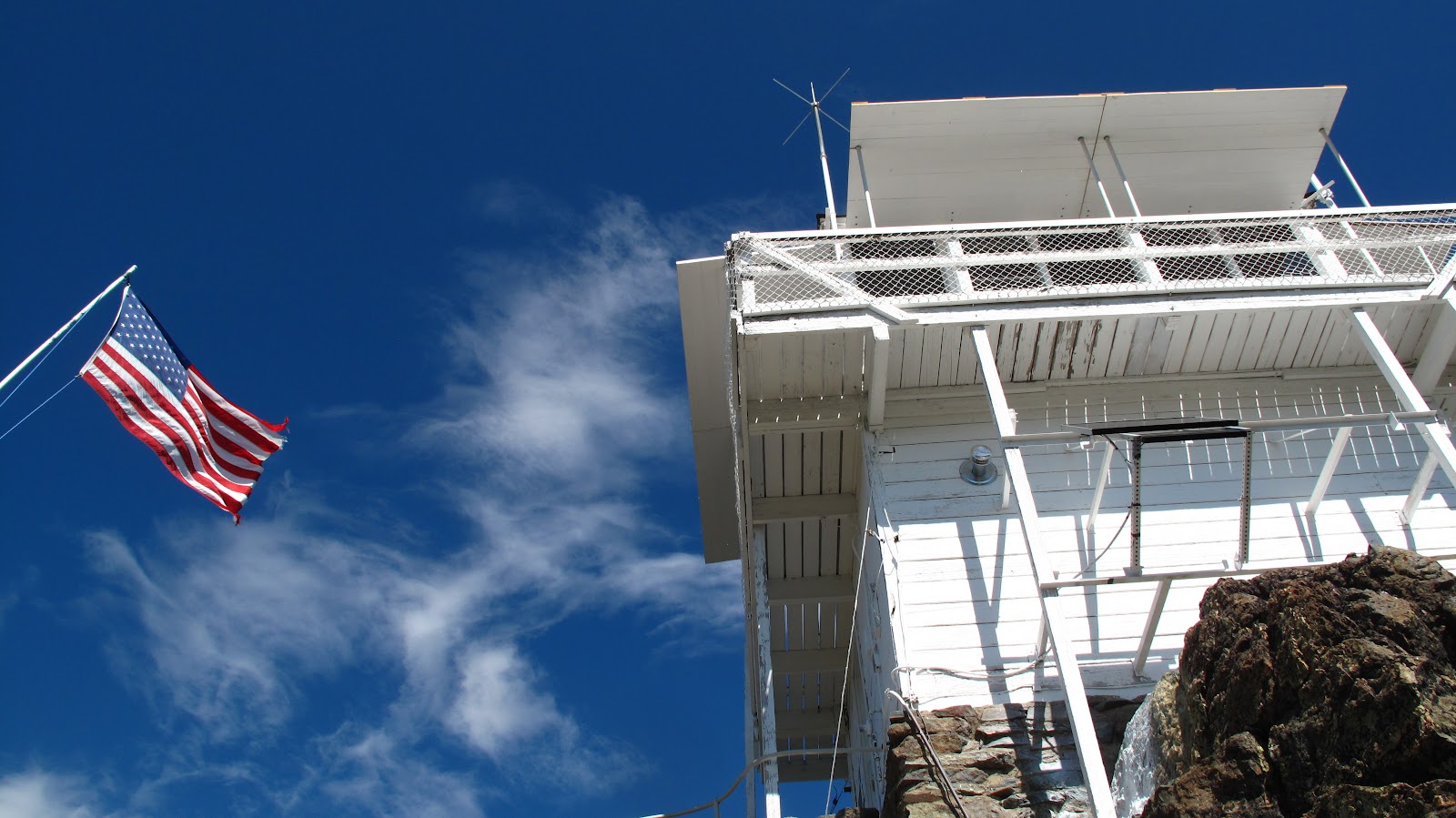
We went up to Mills Peak fire lookout station and found a "manned" fire lookout.  The building was built in the 1930's and has weathered the severe conditions very well.


I spent some time talking with the Ranger who also "manned" the fire lookout.  He said that there would probably be over 150 visitors on this beautiful September Saturday.  Through the glass you can see him looking off toward the northwest with his binoculars.


There is a panoramic view of this lakes region of the Sierras.  The Sierra Valley, source of the Feather River is easily visible to the east, with Mount Lassen visible to the north.

It's hard to believe that we have come back to this area the past four years, and had not been up to Mills Peak.  What other treasures lie waiting in these mountains?

Enhanced by Zemanta

Monday, August 29, 2011

More Politics and Persimmons

In November 2008, after the presidential election I posed a question in a blog post: "Last night, for the first time we both saw the movie "All the Kings Men" starring Broderick Crawford. This morning I looked up Huey Long in Wikipedia and wondered the fate of our new president elect, Barack Obama. At the outset of his political career the character Willie Stark was that rare phenomenon - an honest man.  Abraham Lincoln was an honest man who came to the presidency in a time of national crisis. Will Barack Obama be more like Abraham Lincoln or the fictional character Willie Stark?"

As the presidential race for 2012 heats up this summer, many journalists, bloggers and political hacks have begun the process of analyzing the successes and failures of Barack Obama.


 According to Drew Westen's piece in the New York Times on 8/6/11 "What Happened to Obama?":

"A somewhat less charitable explanation is that we are a nation that is being held hostage not just by an extremist Republican Party but also by a president who either does not know what he believes or is willing to take whatever position he thinks will lead to his re-election. Perhaps those of us who were so enthralled with the magnificent story he told in “Dreams From My Father” appended a chapter at the end that wasn’t there — the chapter in which he resolves his identity and comes to know who he is and what he believes in."

Westen makes a case that we need a president whose stories make sense of what we are going through.  Abraham Lincoln told stories that made sense of the carnage and sacrifice of the Civil War.  Franklin Roosevelt created a narrative that explained the economic crisis of his era and his concrete plans to end the Depression.  "Beginning in his first inaugural address, and in the fireside chats that followed, he explained how the crash had happened, and he minced no words about those who had caused it".


Further, Westen concludes, "when faced with the greatest economic crisis, the greatest levels of economic inequality, and the greatest levels of corporate influence on politics since the Depression, Barack Obama stared into the eyes of history and chose to avert his gaze. Instead of indicting the people whose recklessness wrecked the economy, he put them in charge of it. He never explained that decision to the public — a failure in storytelling as extraordinary as the failure in judgment behind it."

 From a somewhat different perspective, David Frum writing for CNN, 08/29/11, "Obama's three big mistakes" concludes that "Obama made three crucially bad economic decisions in the first year of his presidency".  These included allowing the Democratic Congress to "lard up" the stimulus bill with huge sums that did not create jobs, build infrastructure, or stimulate the economy.  An interesting parallel with the 1930's is that Roosevelt built infrastructure on a massive scale that we still depend on today.  Of the ARRA funds expended, only about one dollar in eight has gone to new infrastructure projects. 

We can expect a new initiative from the president this September to stimulate job growth.  I expect that it will be too little and too late.  His enemies on the right will not accommodate a plan to boost Obama's image before the 2012 election.  And Obama has not demonstrated that he will fight the right wing bullies. 

The persimmons are dropping prematurely this year, and there will be a small crop.


Sunday, August 7, 2011

Napa Porchfest 2011 - Part 2

Napa Porchfest was embraced by the artists, homeowners and residents of Napa.  As I drove around the morning of the event distributing yard signs, I found porches all spruced up and ready for visitors.  In Spencers' Addition, also known as "The Alphabet Streets", lovely signs sprang up in gardens.

One house had shade tents set up and chairs for guests.  Another had a colorful sign for the artist playing later that afternoon.  Another house had a popcorn machine ready for the crowd.

On Warren Street in Old West Napa (my neighborhood) there were shade structures, chairs, sidewalk decorations, food and wine ready for visitors.  A great young band named Anadel played here.


At our house, John set up monitors on the porch to show the keyboards of the two grand pianos so that visitors could see all the hands in action.  The group, comprised of John, Melissa, Jeremy and Anne - played a program of Beethoven and John Phillip Sousa.  Mayor Jill stopped by to see "Eight Hands Afoot" in action. 


There was a lot of interest in the classical piano ensemble - so much so - that visitors arrived a half-hour early to get seats.  Fortunately we had some seats available on the porch, as some guest did not seem to get the message that they needed to bring their own chairs.


People arrived on foot, a few by car, and many on bicycles.  The video spot that John created which included the Eagle Cycling Club and members of the Napa Bicycle Coalition helped get the word out that the best way to get around to the 28 venues in 3 hours was to ride a bike!
Charlotte Watter did an outstanding job as the expert representative of the fictional "Napa Heritage Society".

Other videos for the event can be found at the Napa Porchfest channel on Youtube.

Feedback from the community has been extremely positive.  People were thrilled that this event was FREE, was for local residents, featured local talent, and focused on our own very special neighborhoods.  We definitely plan on having a Napa Porchfest in 2012 - so put July 29, 2012 on your calendar now. 


Enhanced by Zemanta